Vietnamese Street Food, Pyrmont Updated August 2026

The Top 5 Health Benefits of Eating Pho

Somebody starts our broth before most of Sydney is awake. Here is what all those hours actually do for you, and the one honest catch nobody puts on a menu.

The Short Answer

What is pho, and what is actually in it?

Pho is a Vietnamese noodle soup made of four things: slow simmered broth, rice noodles, thin slices of meat or tofu, and fresh herbs you add yourself at the table. That is it. No cream, no batter, no deep fryer.

It is also the food people ask for when they are run down, when it is freezing, or when they have had a week. There is a reason for that, and it is not magic. It is that somebody spent hours on it.

The broth is the whole job. Bones and water go in a pot with whole spices and stay there for hours. Star anise, cinnamon, roasted ginger, roasted onion, black cardamom, coriander seed, fennel seed and clove. You cannot rush it and you cannot fake it with a powder.

Pho first turns up in written records in northern Vietnam in the early 20th century, with the modern version traced to Nam Dinh Province around 1900 to 1907. When Vietnam was split in 1954 and more than a million people moved south, pho went with them. After 1975 it travelled the world in the suitcases of refugees. It has been a Sydney lunch staple ever since.

We have been making it here since 2011. Fifteen of those years were on Enmore Road, and we are now in Pyrmont. Our beef pho runs on a family broth recipe we have been using for a very long time. Good Food once described it as “hipster pho with a solid history. The recipe comes from the owner’s grandmother.” We will take that.
Benefit One

Why is pho broth good for you?

Because it is mostly water, and it has been cooked for hours with real ingredients instead of thickened with anything.

Simmering bones for a long time draws out gelatin, which is what gives a good broth that slight stickiness on your lips. It is also why a proper pho broth sets a little when it goes cold. That is a sign someone did the work.

The practical bit is simpler than the science. A big bowl of hot liquid is hydrating, it is warming, and it fills you up on almost no fat. Compare that to most things you can get in ten minutes on a lunch break.

Nobody has ever finished a bowl of pho and thought, I wish I had eaten a salad.

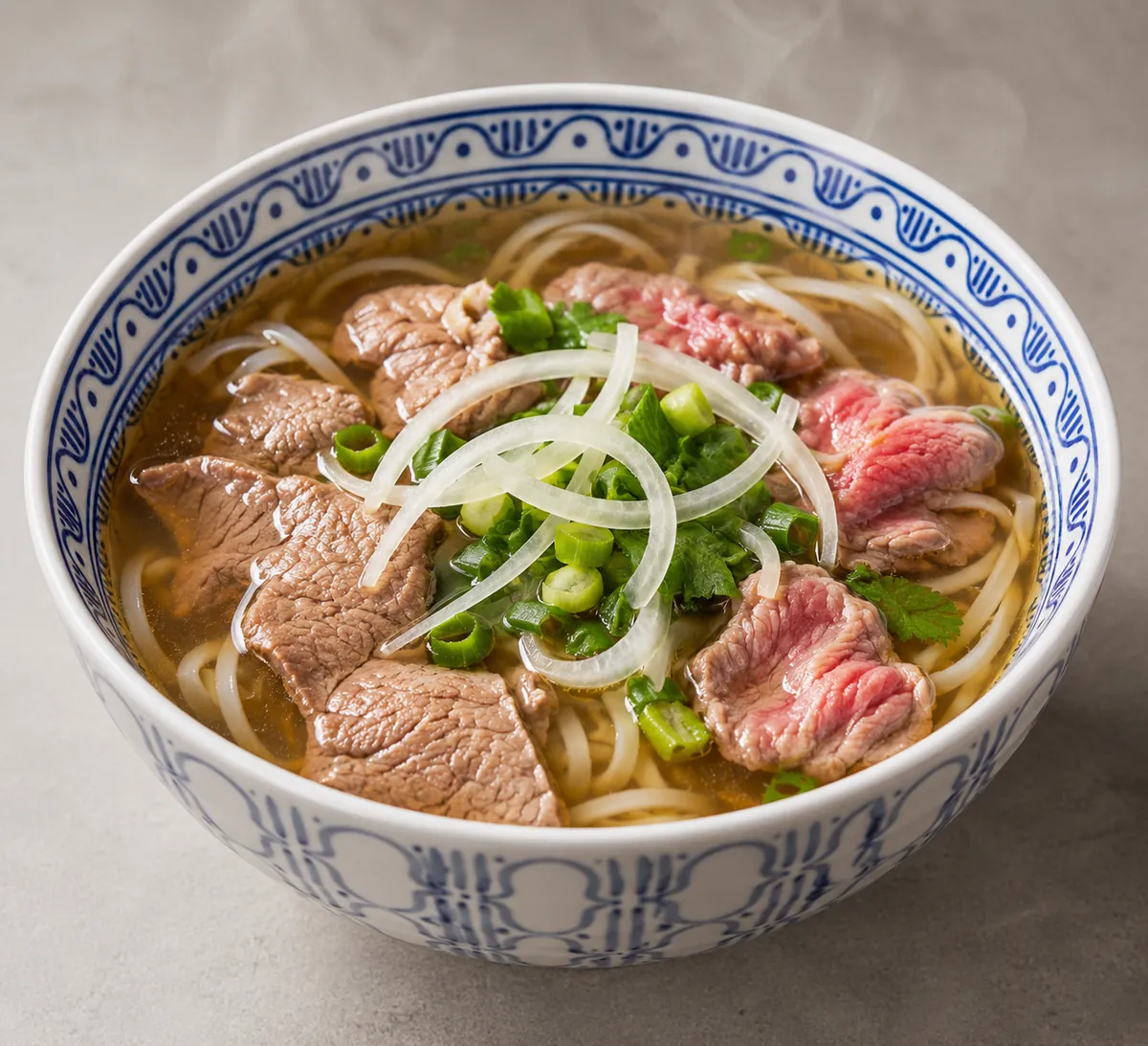
A bowl of Great Aunty Three beef pho with rice noodles, thin sliced beef, spring onion and fresh herbs
Beef pho on the family broth. Hours in a pot, not a powder.
Benefit Two

Does pho have enough protein?

Yes. A bowl comes with a real serve of lean protein, and you get to pick which one.

Thin sliced beef, grilled chicken breast, roast pork or tofu. It is not a side of protein hiding under a pile of carbs. It is the point of the bowl.

At Great Aunty Three you can have beef pho on our family broth, chicken pho in a lighter golden broth, roast pork pho, or a fully vegetarian pho with tofu and vegetables in a vegetarian broth. The vegetarian one is vegan, and it is not an afterthought. We make the broth separately.

See the full menu if you want to know exactly what goes in each one.

Benefit Three

Why do the herbs come on a separate plate?

Because raw beats cooked, and you get to decide how much goes in.

Bean sprouts, Thai basil, coriander, lime and chilli arrive on the side for a reason. Drop them in at the last second and they stay crunchy and fresh. Cook them into the broth and they go limp and taste like nothing.

It also means you are adding a decent handful of raw vegetables and herbs to your lunch without thinking about it. A squeeze of lime gets you some vitamin C on the way through.

Put the lot in. That is what it is there for. The herb plate is not a garnish and it is not optional.

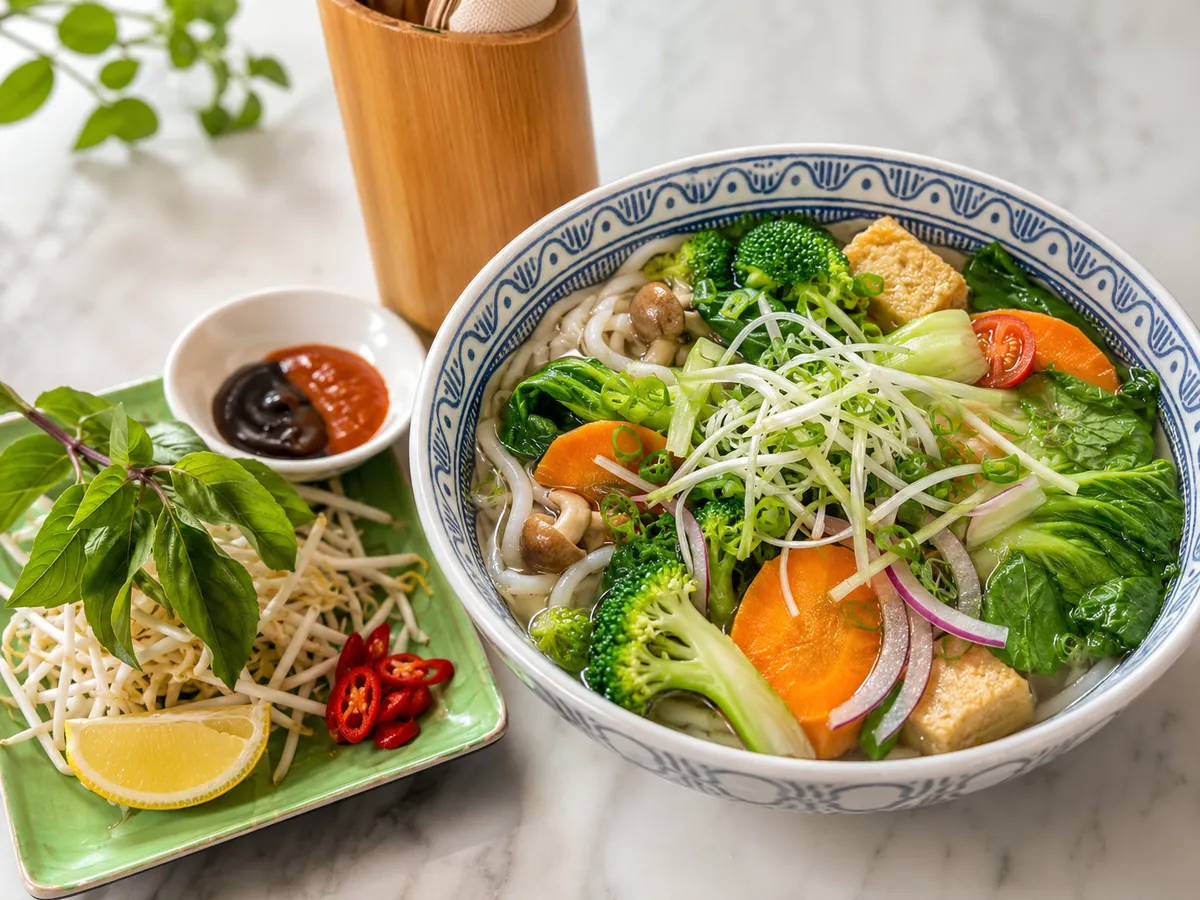
A bowl of Great Aunty Three vegetarian pho with tofu, vegetables, rice noodles and fresh herbs
Vegetarian pho. Separate broth, not the beef one with the beef taken out.
Benefit Four

Is pho gluten free?

The bowl is, because the noodles are made from rice, not wheat. The sauce on the table is where people get caught.

Banh pho noodles are flat rice noodles. No wheat anywhere near them. So if you are coeliac or avoiding gluten, pho is one of the easiest things to order out.

The catch is hoisin sauce. Most commercial hoisin is made with wheat starch, and many recipes add wheat based soy sauce on top of that. Beyond Celiac is blunt about it: unless the bottle says gluten free, assume it is not. So skip the squeeze bottle and use chilli and lime instead. Honestly the broth is better without it, but we are not going to tell you how to live.

If you are ordering with us, just say so. We would much rather you asked than guessed.

Benefit Five

Why does pho leave you full but not heavy?

Because it is hot, it is liquid, and you physically cannot eat it fast.

You get chopsticks and a spoon. You swap between them. You blow on it. The whole thing takes fifteen or twenty minutes whether you like it or not.

That pace does something. Eating slowly gives you time to notice you are full. A bowl of pho tends to end with you satisfied, not needing a lie down and a coffee.

It is also what a lot of people want when they are run down or it is bucketing outside. We are not claiming it cures anything. It is just a very good bowl of hot soup.

The Honest Bit

So is pho actually healthy, or is that just marketing?

Pho is one of the better things you can order for lunch. But it is high in salt, and anyone who tells you otherwise is selling something.

Restaurant broth is seasoned to taste good. That means sodium. A big bowl of it is not a low salt meal, ours included. We are not going to pretend our broth is a health drink.

For context, the Heart Foundation says Australian adults should have no more than 5 grams of salt a day, which is about 2,000 mg of sodium, or roughly one teaspoon. The average Australian eats about 9 grams a day. So most of us are nearly double the mark before we order anything.

We are not going to give you a milligram figure for our bowl, because we have not had it lab tested and we are not going to invent one. What we can tell you is what to do about it.

The simple fix: eat the noodles, the meat and the herbs, and leave some of the broth in the bowl. You lose almost none of the enjoyment and a decent chunk of the salt. That is it. That is the whole trick.

Everything else stacks up. Broth based instead of fried. Rice noodles instead of wheat. Real protein. Raw herbs. Slow to eat. That is a good lunch by any measure.

Why We Care About This

Why does one bowl of soup matter this much to us?

The recipe came from a grandmother in Can Tho, in southern Vietnam. By every account in the family she was the best cook any of them knew, and she ran her own restaurant. People still talk about her food.

Her grandson grew up in Australia, went back to Can Tho, and found street food being sold out of crates and trolleys on buzzing footpaths. He came home wanting to bring that here. In 2008 he quit a stable office job to try, and almost everyone he knew told him not to.

One person backed him. His mum. The same woman who had carried him as a baby on a boat from Vietnam to Australia. He sold the first property she had helped him buy to fund the shop.

She died before it opened. He kept going anyway, and Great Aunty Three became her legacy. Fifteen years on Enmore Road followed. Today Tiffany and her team run the kitchen and carry the same recipes forward in Pyrmont.

So when we talk about a broth that takes hours, we are not doing a marketing line about slow food. We are doing it the way it was taught, by people who gave up a lot to keep it.

The full story is here, and it is worth ten minutes.

Quick Answers

Common questions about pho

Is pho actually healthy?

Pho is one of the better takeaway options. It is broth based rather than fried, the noodles are rice not wheat, and it comes with a pile of raw herbs and vegetables. The one real catch is salt. Restaurant pho is seasoned to taste good, which means it is high in sodium. If you are watching your salt, eat the noodles and meat and leave some of the broth behind.

What are the main health benefits of eating pho?

Five stand out. The broth is slow simmered and mostly water, so it hydrates you. A bowl carries a solid serve of lean protein from beef, chicken or tofu. The herbs and vegetables go in raw at the table, so they keep their crunch and freshness. The noodles are made from rice, so pho is naturally gluten free. And it is warm and eaten slowly, so you tend to finish satisfied rather than stuffed.

Is pho gluten free?

The noodles are made from rice, so the bowl itself is gluten free. Watch the sauces. Hoisin sauce usually contains wheat, so skip it if you need to avoid gluten. At Great Aunty Three in Pyrmont, just tell us and we will sort it.

Where did pho come from?

Pho first shows up in written records in northern Vietnam in the early 20th century. Its modern form is usually traced to Nam Dinh Province between about 1900 and 1907. When Vietnam was partitioned in 1954 and over a million people moved south, pho went with them and became popular across the whole country.

Where can I get good pho in Pyrmont or Sydney?

Great Aunty Three serves beef pho, chicken pho, roast pork pho and a fully vegetarian pho at 5/16-30 Bunn St, Pyrmont NSW 2009. We have been cooking Vietnamese street food in Sydney since 2011, including fifteen years on Enmore Road. Open Tuesday to Sunday, lunch 11:00am to 2:30pm and dinner 5:00pm to 8:30pm. Closed Mondays.

What is in a pho broth?

A proper pho broth is bones and water simmered for hours with whole spices. The usual line up is star anise, cinnamon, roasted ginger, roasted onion, black cardamom, coriander seed, fennel seed and clove. No powders and no shortcuts. That is where the flavour comes from, not from the toppings.

Since 2011

Where can you get proper pho in Pyrmont and Sydney?

Great Aunty Three is at 5/16-30 Bunn St, Pyrmont NSW 2009. We have been cooking Vietnamese street food in Sydney since 2011, including fifteen years on Enmore Road before we moved.

Open Tuesday to Sunday. Lunch 11:00am to 2:30pm, dinner 5:00pm to 8:30pm. Closed Mondays.

What else should I try if I like pho?

If pho is your thing, the banh mi is the other half of the argument. Same kitchen, completely different experience, and it has its own story worth knowing.

Sources

Where do these facts come from?

We are not going to make a health claim we cannot back. Here is where the facts above come from.

One honest note. We have not had our own broth lab tested for sodium, so we have not quoted a number for it. When we can measure it, we will publish it.

Page last updated 13 August 2026.