Vietnamese Street Food, Pyrmont Researched and sourced · Updated August 2026

The History of Pho, From Colonial Hanoi to Sydney

You have probably heard the French invented pho. They did not. What actually happened is a better story, and it starts with an animal nobody in Vietnam wanted to eat.

The Short Answer

Where did pho come from?

Pho came from northern Vietnam, some time between about 1900 and 1910. There is no single invention date, and anyone who gives you one is guessing.

The province usually named is Nam Dinh. The villages of Van Cu and Dao Cu are widely described as the traditional home of the craft. The oldest surviving picture of a pho vendor comes from a French colonial survey of Hanoi street life produced between 1908 and 1910.

And the line that gets repeated most often, that the French invented it, is wrong. But it is wrong in an interesting way, which is what the rest of this is about.

Before Pho

What were Vietnamese people eating before pho existed?

A dish called xao trau. Stir fried strips of water buffalo meat, served in broth over round rice vermicelli.

It was ordinary street food in Hanoi in the early 1900s. Buffalo, not beef, because cattle in Vietnam were working animals. You did not eat the animal that pulled your plough. It was worth more alive.

So the shape of pho already existed. Broth, noodles, meat, herbs. What was missing was the beef, and the long simmer that beef bones make worthwhile.

1858 to 1887

How did French colonisation change what Vietnam ate?

It created a beef industry in a country that did not have one.

The dates are well documented:

  • 1858. A French fleet under Admiral Rigault de Genouilly attacks Da Nang, then called Tourane.
  • 5 June 1862. The Treaty of Saigon. Vietnam cedes three southern provinces and Poulo Condore, opens trade ports, and legalises Catholic practice.
  • 1867. France takes three more provinces, completing control of the south.
  • 1883 to 1884. France establishes protectorates over Annam and Tonkin, the centre and the north.
  • 17 October 1887. French Indochina is formally created.

Here is the part that matters for a bowl of soup. French colonists wanted steak. Vietnamese kitchens did not. So butchers started killing cattle for French tables, and every carcass left behind the parts the French did not want. Bones. Tendon. Flank. Brisket.

Cheap, plentiful, and perfect for a long simmer. If you want to know why pho is built on bones rather than prime cuts, that is the whole reason.

1908 to 1910

When was pho first written down?

The oldest solid evidence is pictorial, not written, and it dates to 1908 to 1910.

A French administrator named Henri Oger ran a project documenting daily life in and around Hanoi, published as Technique du peuple Annamite. It is thousands of woodblock illustrations of ordinary people doing ordinary things, and among them are street vendors carrying the portable soup kit that pho sellers used.

That is roughly the same moment food historians place the switch from buffalo to beef, around 1908 to 1909, when vendors began buying scraps from the butchers supplying the French.

The most detailed timeline of this comes from Vietnamese researcher Trinh Quang Dung, whose 2010 essay 100 Nam Pho Viet, meaning 100 years of Vietnamese pho, traces the dish from xao trau to what we eat now.

So the honest position is this. Pho was not invented on a date. It drifted into existence over about a decade, one substitution at a time.

The Name

Does the word pho come from the French pot-au-feu?

Probably not, even though it is the story everybody tells.

The popular version says pho comes from feu, the French word for fire, as in the beef stew pot-au-feu. It is a lovely story. Two problems with it.

First, the sound does not work. The French feu is not pronounced the way pho is. Linguists have pointed this out for decades.

Second, there is a better candidate. Most language scholars favour a Chinese origin: the Cantonese dish ngau yuk fan, written 牛肉粉, which means beef noodles. Vietnamese forms like nhuc pho shorten neatly to pho. A Vietnamese dictionary from around 1930 already defined pho by way of phan, the Vietnamese pronunciation of the Chinese word for flat rice noodle. Scholars including Le Ngoc Tru have supported this reading.

There is also a plausible physical path for it. Chinese vendors were selling beef noodle dishes in Hanoi at exactly the time pho was forming, around 1908 to 1909. Words travel between people standing next to each other.

So where did the French story come from? Most likely Gustave Hue's 1937 dictionary, which linked chao pho to pot-au-feu. Once a dictionary says it, everybody says it.

We are not going to pretend this is fully settled. It is not. But if you want the version the evidence actually supports, it is the Cantonese one.
The Verdict

So did the French invent pho or not?

No. The French did not bring the recipe, the noodles, the herbs or the name. What they brought was the beef.

That distinction is the whole story, and it is why the lazy version annoys people who know the history.

Colonisation changed what was available in a Vietnamese market. Vietnamese cooks then did what cooks always do, which is make something good out of what is in front of them. They took an existing buffalo soup, swapped in the cheap beef bones the colonists did not want, changed the noodle, and built the spice profile themselves.

Star anise, cinnamon, roasted ginger, roasted onion, black cardamom, coriander seed, fennel seed and clove. There is nothing French in that list. That is a Vietnamese spice cabinet.

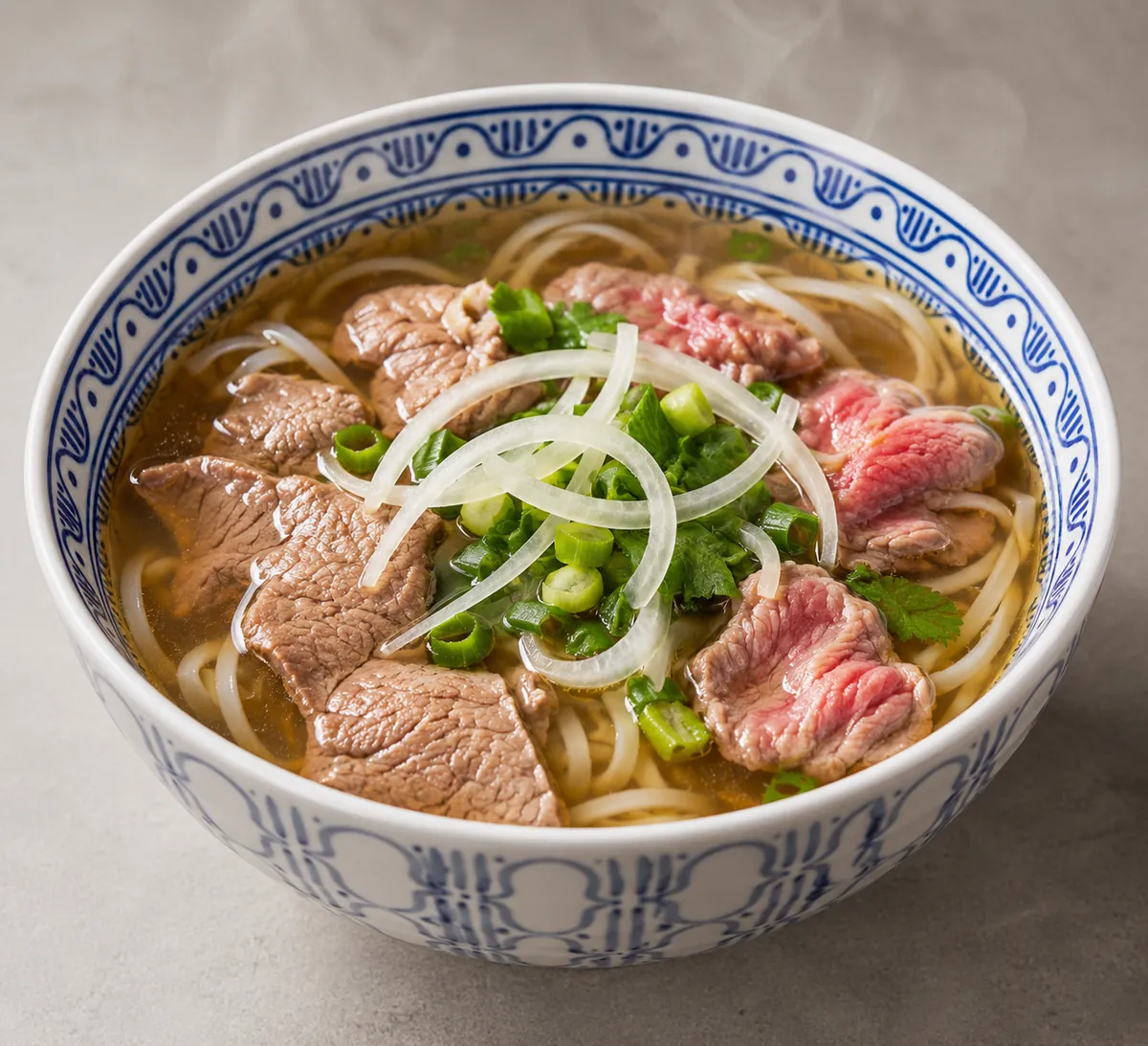
A bowl of beef pho showing the clear spiced broth, flat rice noodles and thin sliced beef
The broth is the whole argument. Everything else is a topping.

Pho is not a colonial dish. It is a dish that was made in spite of one.

Nam Dinh

Where exactly did pho start?

Nam Dinh Province, and specifically the villages of Van Cu and Dao Cu.

Van Cu is usually called the cradle of the pho making craft. The village already made rice vermicelli and noodle sheets. In the wet season, when there was no sun to dry the sheets properly, they sliced the fresh sheets into thin strands instead. That improvised noodle, served in a crab broth, is an early ancestor of what we now call banh pho.

Nam Dinh also happened to be an industrial town under the French, and industry means workers, and workers need feeding fast and cheap. That is the environment street food is born in, everywhere in the world.

Vietnam made this official in 2024, recognising Hanoi style and Nam Dinh style pho as national intangible cultural heritage. Vietnam has also observed 12 December as Day of Pho since 2017.

1918 to 1930

How did pho get to Hanoi and become famous?

Village cooks carried it there, and by 1930 it was everywhere.

  • Around 1918. The first fixed pho stands appear in Hanoi. Before that it was mobile, carried on a shoulder pole.
  • Around 1925. A man from Van Cu named Van opens what is described as the first Nam Dinh style pho stand in Hanoi.
  • By 1930. Pho has spread across Hanoi's commercial districts.

Twenty years from cheap substitute to the food a capital city is known for. That is fast.

1954

Why are there two completely different styles of pho?

Because the country was split in half, and over a million people moved.

The Geneva Accords of 21 July 1954 partitioned Vietnam. More than a million people went from north to south, and they took pho with them into a city that barely ate it.

The south did what the south does. It made it sweeter and put more on the table.

Northern and southern pho compared
Northern phoSouthern pho
Clearer, plainer brothSweeter, fuller broth
Spring onion, not much elseBean sprouts, lime, Thai basil, chilli on the side
PuristGenerous
Sauce is rareHoisin and sriracha showed up later

Most pho served outside Vietnam, Sydney included, is descended from the southern style. If you have ever been handed a side plate of herbs and wondered why, that plate is a souvenir of 1954.

A bowl of Great Aunty Three chicken pho in a light golden broth with rice noodles and herbs
Chicken pho in the lighter golden broth.
1975 Onwards

How did pho get to Sydney?

People carried it. That is the entire mechanism.

After the fall of Saigon in 1975, Vietnamese refugees resettled across the world, including in Australia. The first pho restaurant in the United States opened in 1980 in Orange County, California. The same pattern played out here.

This is why Sydney has real pho and not a version of it. It did not arrive as a trend or a franchise. It arrived with families who had been making it their whole lives, and it stayed in those families.

Great Aunty Three is one small part of that. The recipe came from a grandmother in Can Tho who ran her own restaurant. Her grandson was carried to Australia on a boat as a baby, went back years later, ate street food out of crates on a footpath, and could not let it go. In 2008 he quit an office job to try it here. His mother sold up to help him and died before the shop opened.

We opened in 2011 and spent fifteen years on Enmore Road before moving to Pyrmont. Tiffany and her team run the kitchen now. Good Food once described the pho as “hipster pho with a solid history. The recipe comes from the owner’s grandmother.” They had no idea how right that was. The full story is here.

The Timeline

What is the full timeline of pho?

Timeline of pho from 1858 to 2024
WhenWhat happened
1858French forces attack Da Nang
5 June 1862Treaty of Saigon cedes three southern provinces to France
1867France completes control of southern Vietnam
1883 to 1884Protectorates established over Annam and Tonkin
17 October 1887French Indochina formally created
Early 1900sXao trau, buffalo in broth over vermicelli, sold in Hanoi
1900 to 1907Modern pho takes shape in Nam Dinh Province
1908 to 1909Vendors switch from buffalo to cheap beef from French butchers
1908 to 1910Henri Oger's survey illustrates Hanoi pho vendors
Around 1918First fixed pho stands in Hanoi
Around 1925Van, from Van Cu, opens a Nam Dinh style stand in Hanoi
By 1930Pho established across Hanoi
1937Gustave Hue's dictionary links chao pho to pot-au-feu
21 July 1954Geneva Accords partition Vietnam, pho moves south
1975Fall of Saigon, pho spreads worldwide with refugees
1980First pho restaurant in the United States opens in California
2011Great Aunty Three opens in Sydney
2017Vietnam designates 12 December as Day of Pho
2024Hanoi and Nam Dinh pho named national intangible cultural heritage
Quick Answers

Common questions about the history of pho

Where did pho come from?

Pho came from northern Vietnam, and the evidence points to a window of roughly 1900 to 1910 rather than a single invention date. The province usually named is Nam Dinh, and the villages of Van Cu and Dao Cu are widely described as the traditional home of the dish. The earliest surviving pictorial record is a set of woodblock illustrations of Hanoi street vendors in Henri Oger's Technique du peuple Annamite, produced between 1908 and 1910.

Did the French invent pho?

No. The French did not bring the recipe, the noodles or the name. What French colonisation did bring was beef. Cattle in Vietnam were working animals, not dinner. French demand for steak created a supply of bones and offcuts that Vietnamese butchers and street vendors could buy cheaply, and that is what made a long simmered beef broth possible. The dish is Vietnamese. The beef supply was a colonial side effect.

What did Vietnamese people eat before pho?

A dish called xao trau, which was stir fried strips of water buffalo meat served in broth over round rice vermicelli. It was common in Hanoi in the early 1900s. Around 1908 to 1909 vendors began swapping in cheap beef scraps from butchers who supplied the French, and swapping the round vermicelli for flat rice noodles. That swap is the closest thing pho has to a moment of birth.

Does the word pho come from the French pot-au-feu?

Probably not, although it is the most repeated story. Most linguists favour a Chinese origin, from the Cantonese dish ngau yuk fan, written 牛肉粉, meaning beef noodles. In that reading pho is a clipping of earlier Vietnamese forms like nhuc pho. The pot-au-feu theory has a phonetic problem too, because the French feu is not pronounced the way pho is. Gustave Hue's 1937 dictionary did link chao pho to pot-au-feu, which is likely where the story took hold.

What is the difference between northern and southern pho?

The 1954 partition of Vietnam sent over a million people from north to south, and pho went with them. Northern pho, the older style, is plainer and clearer, with spring onion and not much else. Southern pho picked up a sweeter broth and a plate of extras on the side: bean sprouts, lime, Thai basil, chilli, and later hoisin and sriracha. Most pho served outside Vietnam, including in Sydney, is descended from the southern style.

How did pho get to Australia?

After the fall of Saigon in 1975, Vietnamese refugees resettled around the world, including in Australia. They brought the food with them. That is why Sydney has genuinely good pho rather than an imitation of it. Great Aunty Three has been part of that story here since 2011, first through fifteen years on Enmore Road and now from our kitchen at 5/16-30 Bunn St, Pyrmont.

Since 2011

Where can you eat proper pho in Pyrmont and Sydney?

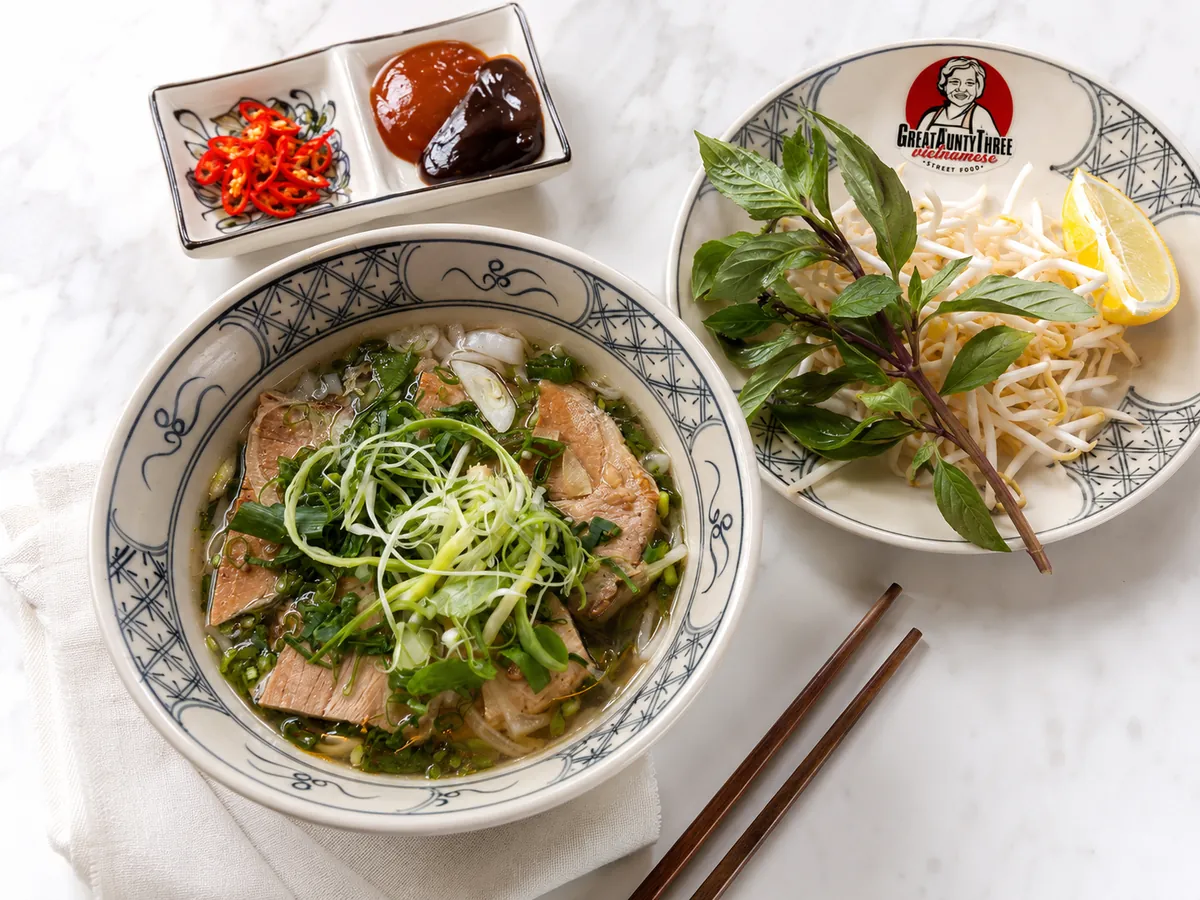
Great Aunty Three is at 5/16-30 Bunn St, Pyrmont NSW 2009. Beef pho on our family broth, chicken pho in a lighter golden broth, roast pork pho, and a fully vegetarian pho with its own separate broth.

Cooking Vietnamese street food in Sydney since 2011, including fifteen years on Enmore Road.

Open Tuesday to Sunday. Lunch 11:00am to 2:30pm, dinner 5:00pm to 8:30pm. Closed Mondays.

What should I read next?

Sources

Where do these facts come from?

Every date above was checked against these before publishing. Where sources disagree, we have said so in the text rather than picking the tidier version.

One honest caveat. Several of these dates are the best available reconstruction rather than a primary document. Street food is not usually written down while it is happening. Where you see the word around in this article, that is why.

Page last updated 13 August 2026.